


In the context of continuously rising temperatures, industrial metal roofs can absorb heat up to 60–80°C, making indoor spaces uncomfortably hot, increasing cooling energy consumption, and directly affecting production efficiency.
Currently, there are several common cooling solutions on the market such as insulated roofing sheets, thermal insulation panels, ventilation systems, and heat-reflective coatings. However, each solution differs in terms of effectiveness, cost, and durability.
The following article provides an overall comparison of the most popular cooling solutions, helping you choose the most suitable option for your facility.
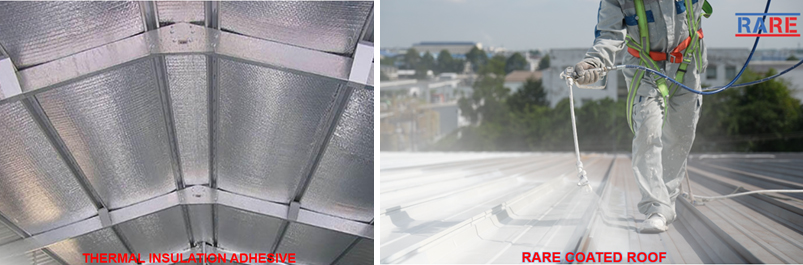
| Criteria | RARE Paint | Insulation Sheet / Panel | Other heat-reflective coatings |
| Principle | Reflection + Radiation | Insulation: When sunlight directly hits the roof surface, materials such as foam/PE/PU, fiberglass, etc., help insulate and reduce heat transfer into the building interior. | Reflection: When the coated surface is directly exposed to sunlight, the hollow microspheres expand, forming micro air gaps that act as an insulating layer.
Additionally, the paint contains TiO₂ and SiO₂ particles, which enhance solar reflectivity, thereby reducing heat transfer into the building interior. |
| Heat Reduction Effect | Under extreme sunny conditions, RARE paint can reduce the surface temperature by up to 40°C, while the indoor temperature decreases by approximately 10–15°C (depending on roof type, material, and thickness). | Initially effective; however, over time, the material tends to retain heat and radiate it back into the interior space, causing the cooling effect to gradually diminish and the indoor environment to become hot again. | Under extreme sunny conditions, the surface temperature is reduced by 5–10°C, resulting in limited effectiveness |
| Lifespan | >10 years, with a 5-year warranty. UV-resistant, dust-resistant, rust-resistant, etc. | 2–5 years, prone to peeling and deterioration, requiring replacement | 3–5 years, heat-insulating effectiveness is almost lost, and the coating is prone to peeling due to the differing expansion coefficients of the roof and the paint. |
| Application | Quick application depending on the area (no roof dismantling required, does not affect factory operations). | – Requires cutting, gluing, and screwing; difficult to apply over large areas; joints are prone to gaps, which can affect production processes.
– Difficult to pass fire safety inspection. In case of roof leakage, large sections must be dismantled to locate the leak. Moreover, after long-term use, the material may degrade, releasing micro particles that are harmful to human health |
Similar to RARE coating, easy to apply. |
| Aesthetics appeal | The surface is coated with a bright white, smooth, and glossy finish, enhancing aesthetics. | Visible joints, rapid deterioration, color fading, peeling, resulting in loss of aesthetic appeal | The painted surface deteriorates rapidly within the first 1–2 years after application, causing peeling, uneven patches, and loss of aesthetic appeal |
Each cooling solution has its own advantages and limitations, depending on the current condition of the facility and the available investment budget.
However, for operational factories, an optimal solution must simultaneously meet key requirements: high efficiency, fast application, no disruption to production, and long-term cost savings.
Within this trend, radiative cooling coatings such as RARE Radiative Cooling Paint are increasingly being adopted by many enterprises thanks to their ability to directly reduce roof surface temperature and deliver long-lasting performance over time